
Turf ordering

Turf ordering

When you order your turf we need to know the dimensions of the area and your location so we can give you a quote. If this is the first time you’ve bought turf some of the following information could be helpful for you.

Turf ordering

When you order your turf we need to know the dimensions of the area and your location so we can give you a quote. If this is the first time you’ve bought turf some of the following information could be helpful for you.

We now cut turf in square metre rolls. But we can work out your turf requirements whether you have measured in metres or yards and feet without any difficulty.

If your patch is square or rectangular it is a simple matter of length x width. If some of the edges of your area are a bit wiggly or slightly slanted the best approach is to “square-off” the measurements you take. That way you will certainly cover the area with just a small amount of wastage where the edge falls inside the rectangle.

Tricky shapes can be hard to estimate and inevitably you could end up ordering too few or too many turf. We will do all we can to help you get it as near as possible but please be aware that we cannot take back any turf which you have surplus. If you find you have spare rolls you could see if a neighbour could use it. Or if you unroll the turf and keep it watered, even just left on concrete the grass will remain healthy and reusable for as long as 2 weeks.

If you use up all the rolls you ordered and find you need just a few more this may be less than our minimum order quantity. However for small quantities you can go to the garden centres we supply and collect some. Please contact us so we can tell you the nearest to you and when they will have a fresh supply. Or you can see their phone numbers on our “Garden Centres” page.

For awkward shapes there are some approaches that we suggest. Where it is quite a large area and very hard to calculate, for example due to lots of curved edges, for which there isn’t really a means of calculating, you could under-order and focus on laying the most wiggly parts first. This hopefully leaves you with the final part which is easier for you to measure.

We are also happy to have a look at your sketch or detailed plan to see if we can work it out for you. You can send this to us by fax or email, or call in to the office with it. There is no charge for any of this help with ordering but unfortunately we cannot visit your site to measure. The exception to this would be if you ask us to arrange a laying service for you.

Whatever your requirements we will always advise you what different options we can identify, what the cost and other implications are and try to help with your decision.

We supply quality turf all year round. If you would like any further advice on lawn care or would like to talk to us about your order, please contact us on 01392 231040 or email sales@wesellturf.com

Contact us

01392 231040
sales@wesellturf.com

Office address

HCT Turf
The Old Stable
Clyst Road
Topsham
EX3 0DB

Social media

Did you know that we supply quality screened topsoil?

Did you know that we supply quality screened topsoil?

Enough topsoil of suitable quality is essential for any successful garden or landscaping project. You may find that the quantity or quality of the soil at your site needs increasing or improving. We keep a stock of general purpose sandy loam topsoil which many of our customers buy as part of their turfing project.

Did you know that we supply quality screened topsoil?

Enough topsoil of suitable quality is essential for any successful garden or landscaping project. You may find that the quantity or quality of the soil at your site needs increasing or improving. We keep a stock of general purpose sandy loam topsoil which many of our customers buy as part of their turfing project.


Topsoil for laying turf on

We recommend laying turf on a 10-15cm layer of topsoil for it to grow successfully. If your plot doesn’t have enough then our screened topsoil is the ideal material to put down.   It can be mixed with your existing soil or just added on top. We can calculate how much soil you would need from your measurements and give you a quote – just call or email us to ask.

Topsoil for planting beds

You might want to add some compost or other specific nutrients if you plan to grow something particular when using it for beds. All our batches of soil have been tested so we can let you have that information: nutrient levels, pH, etc.

Delivery – loose topsoil

Our screened topsoil is delivered loose and tipped in quantities from 2 tons upwards. Our small tipper lorry carries up to 7 tons. Larger quantities can be delivered on 6- or 8-wheeler lorries which carry 16 and 20 tons respectively.


Bagged topsoil

We can supply bagged soil on request, that’s approximately 800kg. Give us a call if you’d like more information.


About our topsoil

We operate an Environmental Permit at our site just near to J30 of the M5 for handling locally sourced topsoil. Topsoil that is to be moved must have contaminant tests done on multiple samples. These tests enable us to establish if it is suitable for residential use before we accept it. But crucially we only handle material that is low clay-content, nutritious and easy to handle and our customers want to come back for all their projects.

We’ll then screen the soil at our site and test samples against BS 3882:2015. This standard gives information about nutrients, structure, pH, etc in a handy one-page format that we can send out on request.  You can also chat with us about the characteristics of the soil and get a free sample.

We supply quality turf all year round. If you would like any further advice on lawn care or would like to talk to us about your order, please contact us on 01392 231040 or email sales@wesellturf.com

Contact us

01392 231040
sales@wesellturf.com

Office address

HCT Turf
The Old Stable
Clyst Road
Topsham
EX3 0DB

Social media
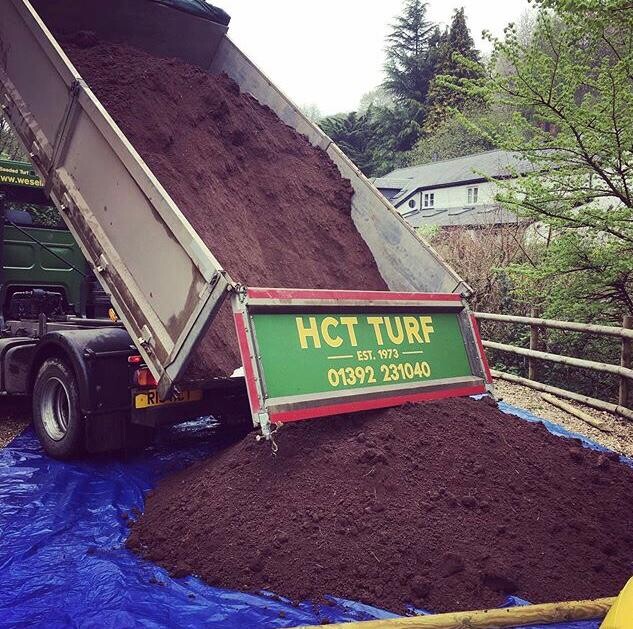
Is spring the best time to lay turf?

Is spring the best time to lay turf?

Waving goodbye to winter brings renewed hope and energy to gardeners and a sense of purpose and positivity. Spring brings with it new buds, new growth and the impetus to be outside.

Is spring the best time to lay turf?

Waving goodbye to winter brings renewed hope and energy to gardeners and a sense of purpose and positivity. Spring brings with it new buds, new growth and the impetus to be outside.

One of the main focal points to notice after the long winter months will be the condition of your lawn (See our lawn care tips for spring time). Or for those gardeners considering new projects it might be time to lay turf.

Is spring the best time to lay turf?

Turf is one of the most under-estimated aspects of any garden, and with spring fast approaching, most think this is the best (and only time) to lay turf. Yet turf can be laid any time of year. We think autumn is the optimal time, but laying turf in spring is absolutely fine and can transform any sized project instantly.

With the promise of lazy summer days, entertaining on the lawn, and perhaps a spot of croquet, gardens will need to look their best. For some, spring is therefore seen as the most convenient time to lay down a new lawn.

What are the advantages of laying turf in spring?

Conditions in spring time are very favourable. As you are working with nature, days are generally milder and longer, rainfall is gentle, providing appropriate irrigation and moisture for root growth to establish at a faster rate.

The temperature of the soil is warmer in spring, giving plants the ability to put down roots for immediate growth. The soil will also be much easier to work with.

If soil quality is poor it’s important to use a pre-turfing fertiliser before turf is laid. Your local garden centre will be able to recommend a suitable product.

The disadvantages of laying turf in spring

Turf laid in the spring will need extra watering, especially during extreme dry spells during the summer. Dry soil may stress the turf and delay rooting. For large areas make sure you have arranged irrigation or consider whether you can delay your turf project until the autumn. Small areas are easier to manage with a sprinkler.

There may be a shortage of turf during the spring months at garden centres as supplies run dry due to popularity. But don’t let that deter you, we are on hand to advise where and when you can find stocks of our turf, and of course we are here to supply too.

Care guide when laying turf

Turf provides an instant lawn effect but it is important to prepare the soil well before laying, as you would grass seed. (See our guide to preparing your soil for turf).

Don’t be tempted to mow your grass before it is fully rooted as this stresses turf and may delay rooting.

We advise you to lay turf on the day of delivery during the spring. If this is not possible, we recommend you unroll the turf in a holding area and water it regularly.

Do not under-water your newly laid turf, as this may result in shallow rooting. The water applied needs to be sufficient to penetrate and soak the soil underneath the turf in order to encourage the news roots downwards. There is no need to feed it for the first 3-6 months as it arrives fully fertilised.

In order for your new turf to settle in stay off it, ideally for at least 3-4 weeks, to enable it to establish and really set down its roots, so it can become a thing of beauty throughout the summer months and beyond.

Summary

  • Conditions for laying turf in spring are favourable, warm and wet
  • When laying turf in spring plan how you will keep it watered including for that first summer
  • Do not mow or run around on the new turf for the first 3-4 weeks

We supply quality turf all year round. If you would like further advice on lawn care this spring or would like to talk to us about your order, please contact us on 01392 231040 or email sales@wesellturf.com

Contact us

01392 231040
sales@wesellturf.com

Office address

HCT Turf
The Old Stable
Clyst Road
Topsham
EX3 0DB

Social media

Quick Guides

Quick Guides

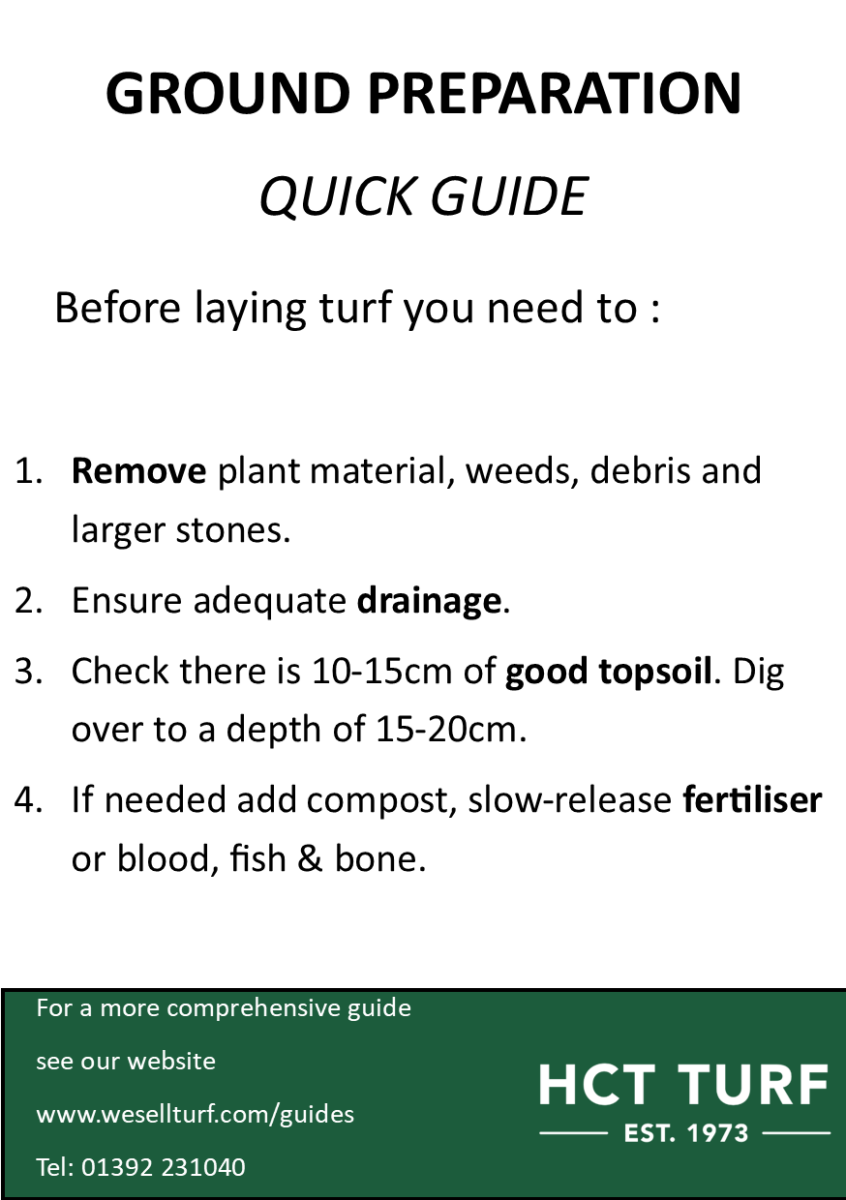
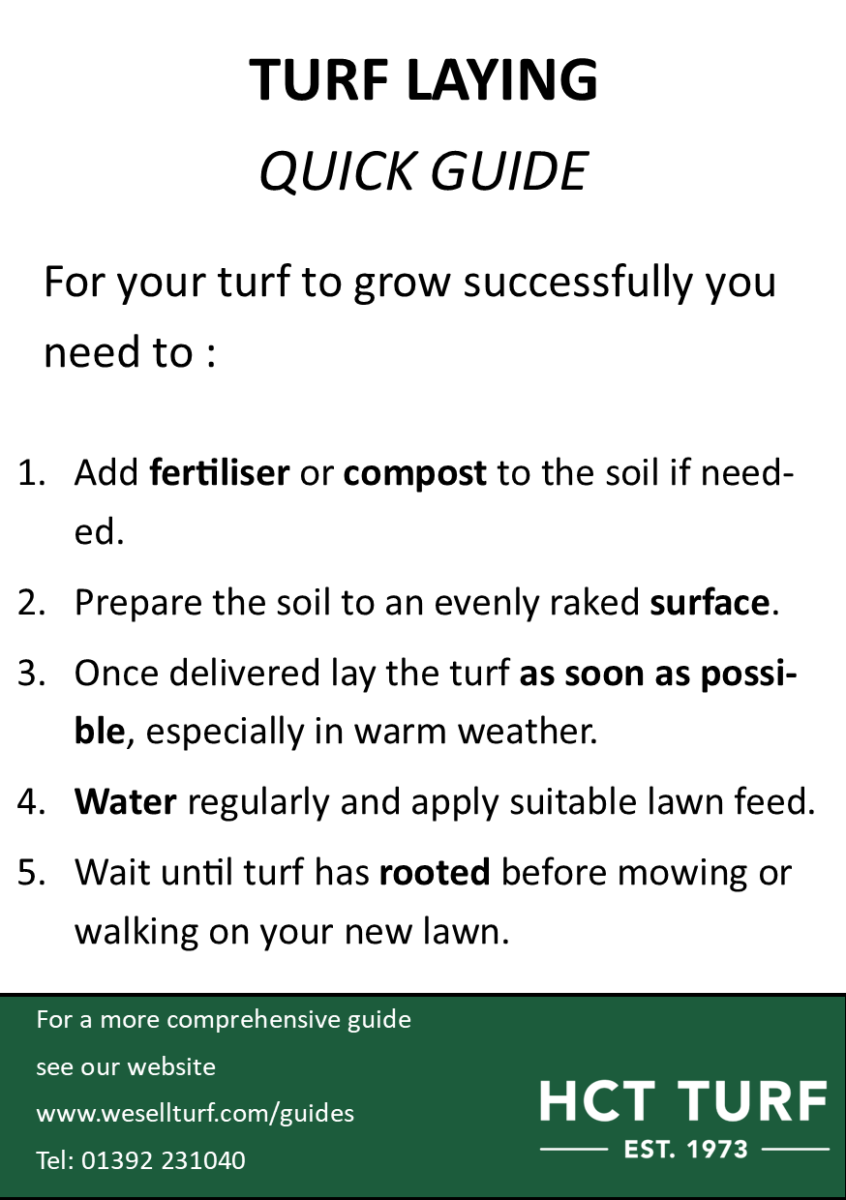
To get you started with preparing your soil and laying your turf – have a glance at our handy Quick Guides below.

For more detailed advice head to our “How to Lay Turf” article.

Quick Guides

To get you started with preparing your soil and laying your turf – have a glance at our handy Quick Guides below.

For more detailed advice head to our “How to Lay Turf” article.

Contact us

01392 231040
sales@wesellturf.com

Office address

HCT Turf
The Old Stable
Clyst Road
Topsham
EX3 0DB

Social media
Turf aftercare

Turf aftercare

Turf aftercare

Newly laid lawn

After laying turf avoid vigorous use to allow it a chance to put down its new roots. This will take 2 to 4 weeks depending on the time of year. It grows a lot slower in the winter. During that time we would advise you to only walk very carefully on it, do not mow it and make sure it has plenty of water. It is easy to underwater but difficult to over water.

Once you can no longer lift up the corner of a turf it has grown in and it’s ok to give its first haircut. The general rule is only ever cut off one third of the length. So if it’s growing very fast you will need to be patient and take a few mows to get it down to the length you want it. Leave 7 days between each cut. By doing this you’ll avoid the grass looking yellow.

Mowing

Once your new lawn has settled in, you can expect to be mowing it once or twice a week from April to October. It’s very much dependent on how cold the winter is but it’s not likely to need any mowing December to February.

Annually

We treat all our turf with fertilisers and nutrients to make it healthy. To keep your lawn at its best we recommend a weed and feed type treatment each spring and autumn which garden centres can supply. Leatherjackets, which are the young larvae of cranefly or daddy long legs, can also be a problem. Please see our separate post on Leatherjackets.

Lawn care, like everything, is something which you could make into a full time job if you have the time and inclination. Other jobs which keep a lawn at its best include scarifying, aerating etc. Refer also to our seasonal advice on lawn care in Spring, Summer, Autumn and Winter.

We supply quality turf all year round. If you would like any further advice on lawn care or would like to talk to us about your order, please contact us on 01392 231040 or email sales@wesellturf.com

Contact us

01392 231040
sales@wesellturf.com

Office address

HCT Turf
The Old Stable
Clyst Road
Topsham
EX3 0DB

Social media
Aeration, why, when and how?

Aeration, why, when and how?

Aerating your turf or lawn is a great way to prep it ready for the summer months. Aeration lets air and water into the soil to encourage better root growth and allows the roots to absorb more nutrients from the soil. It is an important job to do in early spring (March is ideal) After the harsh winter months and when the grass is starting to grow again.

Aeration, why, when and how?

Aerating your turf or lawn is a great way to prep it ready for the summer months. Aeration lets air and water into the soil to encourage better root growth and allows the roots to absorb more nutrients from the soil. It is an important job to do in early spring (March is ideal) After the harsh winter months and when the grass is starting to grow again.

When soil becomes compacted, even slightly, it can inhibit the flow of air, water and nutrients that support thicker, healthier turf growth. Even a thin layer of compacted soil (just 5-10mm) can affect the health and beauty of your lawn.

If you think your turf is compacted, maybe it looks stressed? Or is hard to the touch? Or do you have rain puddles in your lawn? do the screwdriver test. Simply use a regular screwdriver, insert it into your lawn by hand. If it doesn’t slide in fairly easily and it meets some resistance, your soil is likely to be compacted.

Why you should aerate your lawn?

  1. Aeration improves soil water uptake
  2. It helps the roots obtain more oxygen
  3. It helps fertilizer to penetrate into the turf
  4. It reduces water runoff and puddling on your lawn
  5. Aeration promotes stronger turf grass roots
  6. It helps to reduce soil compaction
  7. Aeration helps improve heat and drought stress tolerance
  8. It helps breakdown thatch

How to aerate your lawn.

Aerating is best done when your soil is damp, from either irrigation or rainfall the day before. Overly dry soil can be really tough; however, don’t aerate an overly wet lawn either.

There are three main type of equipment that can be used, from small manual pieces to larger tractor-like machines

Spike aerators. These simply poke a hole down into the soil with a solid spike. The easiest ones to use are aerator “sandals” which you strap to your shoe, and simply walk across your lawn. These are great for homeowners and small areas.

Slicing aerators. These have rotating blades that cut or slice through grass and thatch and down into soil. Like spike aerators, slicing aerators leave soil in the ground, but they create pathways for air, water and nutrients without causing more compaction.

Core or plug aerators. These are typically preferred by lawn professionals. They use rows of hollow spikes that remove plugs of soil from the turf and deposit them on top, where they break down. The size of the plugs and the holes they create vary in width and depth, depending on the machine used.

Many local gardening services can do the job for you, or you can rent equipment from your local hire shop. A lot like mowing, you work back and forth across your lawn, concentrating on problem areas, like pet runs.

We supply quality turf all year round. If you would like any further advice on seasonal lawn care or would like to talk to us about your order, please contact us on 01392 231040 or email sales@wesellturf.com

Contact us

01392 231040
sales@wesellturf.com

Office address

HCT Turf
The Old Stable
Clyst Road
Topsham
EX3 0DB

Social media