
Give your lawn some autumn TLC

Give your lawn some autumn TLC

It’s lovely to see lawns greening up again. With the rain finally returning and grass growth picking up, it’s time to give your lawn a little TLC and help it recover from the dry summer before the cooler months arrive.

The good news is that there is no need to do anything too complicated. A few simple jobs now can make a real difference to the health of your lawn over winter and give it a head start when spring arrives.

Restart mowing

If your grass is growing well, you should now restart mowing. Leaving it to become very long can weaken the lawn and make it harder to manage as growth slows later in the season.

However, resist the temptation to cut it really short. Your lawn is likely to still be recovering from the dry conditions. And a slightly higher cut is always better as we head into autumn, helping the grass cope with cooler and wetter conditions.

You may find patchy areas which look like they need repairing, but perhaps wait for another few weeks before returfing, just to give it a chance.

If the ground becomes very wet, give the mower a miss for a few days. Mowing saturated soil can compact it and leave ruts across the lawn.

Clear away the leaves

The leaves will soon be falling! A scattering of autumn leaves can look lovely, but a thick layer left on the lawn will block light and air from reaching the grass. This can encourage moss and fungal problems, particularly as conditions become damper.

Try to clear leaves regularly, especially after windy days. They can go on the compost heap or be collected separately to make leaf mould.

Give the soil some air

After the long, dry summer, your soil may be compacted, particularly on lawns that have had plenty of foot traffic. Aerating the lawn helps air, water and nutrients get down to the grass roots.

For a smaller lawn, simply pushing a garden fork into the soil at regular intervals can help. If you have a larger lawn, a hollow-tine aerator is worth considering.

Repair those bare patches

Autumn’s combination of cooler temperatures, rain and good grass-growing conditions makes it a great time to repair any areas that were damaged by the summer.

For smaller patches, rake away any dead grass, loosen the soil and sow some suitable lawn seed. Keep it moist while the new grass gets established.

If your lawn has suffered more extensive damage, now is a perfect time to returf, as new turf should have time to establish a good root system before winter really sets in.

Give it an autumn feed

Finally, consider giving your lawn an autumn feed to help strengthen it before winter. Choose a fertiliser formulated for autumn rather than a high-nitrogen summer feed, which encourages lots of leafy growth rather than helping the grass prepare for colder conditions.

A little work now will leave your lawn stronger and healthier as winter approaches – and better prepared to burst back into life next spring.

Key points

  1. Restart mowing – but raise the cutting height.
  2. Keep it clear – regularly remove leaves so they don’t smother the grass.
  3. Give it a boost – repair damaged areas and use a suitable autumn feed to help strengthen the lawn before winter.

If you would like further advice on lawn care  or would like to talk to us about ordering turf, please contact us on 01392 231040 or email sales@wesellturf.com

Contact us

01392 231040
sales@wesellturf.com

Office address

HCT Turf
The Old Stable
Clyst Road
Topsham
EX3 0DB

Social media

How to care for your lawn after a drought

How to care for your lawn after a drought  

After weeks of dry weather over the summer, the current spell of rain is exactly what our lawns need. But while it may be tempting to get the mower out and start tidying things up, your grass needs a little time and care to recover.

The good news is that lawns are remarkably resilient. With the right treatment, even grass that has turned brown and straw-like can often bounce back.

Give your lawn time to recover

The first rule after a drought is simple: don’t rush to mow.

Rain will encourage new growth, but your lawn may still be under stress. Give the grass time to absorb the moisture and start producing fresh green growth before putting it under the additional stress of mowing.

When you do mow, make sure your mower blades are sharp and set them higher than usual. Removing too much of the grass leaf can put unnecessary strain on a lawn that is still recovering. Avoid cutting more than around a third of the grass height at any one time.

Resist the urge to overwater

Once the rain arrives, there’s usually no need to reach for the hose – and for most of us, there’s still a hosepipe ban. Natural rainfall should provide the moisture your lawn needs, particularly if the ground has had a chance to properly rehydrate.

If conditions turn dry again and the hosepipe ban is lifted, occasional deep watering is generally more beneficial than frequent, light watering, as it encourages roots to grow deeper into the soil.

Check for damaged areas

Don’t be too quick to assume that brown grass is dead. If the crowns and roots are still alive, new growth may appear surprisingly quickly once moisture returns.

However, if you have areas that remain bare, thin or heavily damaged after a few weeks of suitable growing conditions, it may be time to consider repairing them.

Small patches can often be reseeded, while larger or badly damaged areas may benefit from returfing. Autumn is an excellent time to lay new turf in the South West, as the combination of warmer soil and increased rainfall gives new grass a good opportunity to establish before winter.

Give your lawn a helping hand

Once your lawn has started actively growing again, gently rake away any dead material and consider aerating compacted areas (for more info check out our tips for aeration here). Aeration helps air, water and nutrients reach the roots and can be particularly useful if the ground has become hard and compacted during a prolonged dry spell.

A suitable autumn lawn feed can also help strengthen grass ahead of winter, but avoid feeding a lawn that is still dormant or visibly stressed.

Most importantly, be patient. Your lawn has survived the drought; now it needs a little time to recover. With sensible mowing, good moisture levels and some autumn TLC, it should soon be looking greener, healthier and ready to face the seasons ahead.

Key points:

  • Don’t mow too soon: Give your lawn a chance to recover first.
  • Damage may not be permanent: Wait to see if new shoots appear.
  • Returf in the autumn: This is an ideal season to lay new turf.

If you would like further advice on lawn care  or would like to talk to us about ordering turf, please contact us on 01392 231040 or email sales@wesellturf.com

Contact us

01392 231040
sales@wesellturf.com

Office address

HCT Turf
The Old Stable
Clyst Road
Topsham
EX3 0DB

Social media
Our Useful Guide to Ordering Turf

HCT’s Guide to Ordering Turf

HCT Turf supplies quality turf across the South West region, and sometimes further afield. This is our useful guide to placing an order.

 HCT supplies to landscapers, developers, golf courses, holiday parks, hotels, parks, councils and residential customers.

Our deliveries are made from Monday through Friday. The time from order to delivery depends on a variety of factors, such as location, the size of the order, how busy we are – and sometimes the weather.

In general, all deliveries are made within one week of the order being placed. However, for local sites, this can be as quick as a day or two. We will discuss and agree delivery when you place your order. If we are delivering close by we may be able to add your order on.

Deliveries are made using our own lorries, although we do also use local hauliers if needed. We will need to ensure sufficient access for the vehicles prior to delivery.

Turf is cut either on the day of delivery or the day before. This helps to ensure the health of the new lawn, although it is also important to lay the turf as soon as possible after delivery to avoid issues such as heat stress.

Please note that for smaller orders under 20sqm (this may be higher for sites further afield) we advise purchasing from one of the garden centres that we supply. During periods when they don’t stock turf, we will try to help when we can.

We have many repeat customers, especially landscapers who we work closely with to make sure that newly turfed or returfed areas look and perform their best. But if you are new to HCT we will be happy to discuss your upcoming projects and set up an account for you.

Should you need turf in a hurry, please call us as soon as possible on 01392 231040 and we will do our best to accommodate your request.

We supply quality turf all year round.  If you would like further advice on lawn care or would like to talk to us about your order, please call us or email sales@wesellturf.com

Contact us

01392 231040
sales@wesellturf.com

Office address

HCT Turf
The Old Stable
Clyst Road
Topsham
EX3 0DB

Social media

Turf or Seed

Turf or Seed

Decisions, decisions! Should you lay turf or sow grass seed to create that lush green lawn you’re after. While you might think we’re likely to say turf is the way to go, here we’ve considered both sides of the coin.

Turf V Seed

One of the dilemma gardeners face is whether to lay turf or to sow grass seed to create that lush green lawn. Of course you’d think we are likely to say turf is the best option, but we’ve looked at both sides of the coin. One option may be better for you than the other….


Pros and Cons

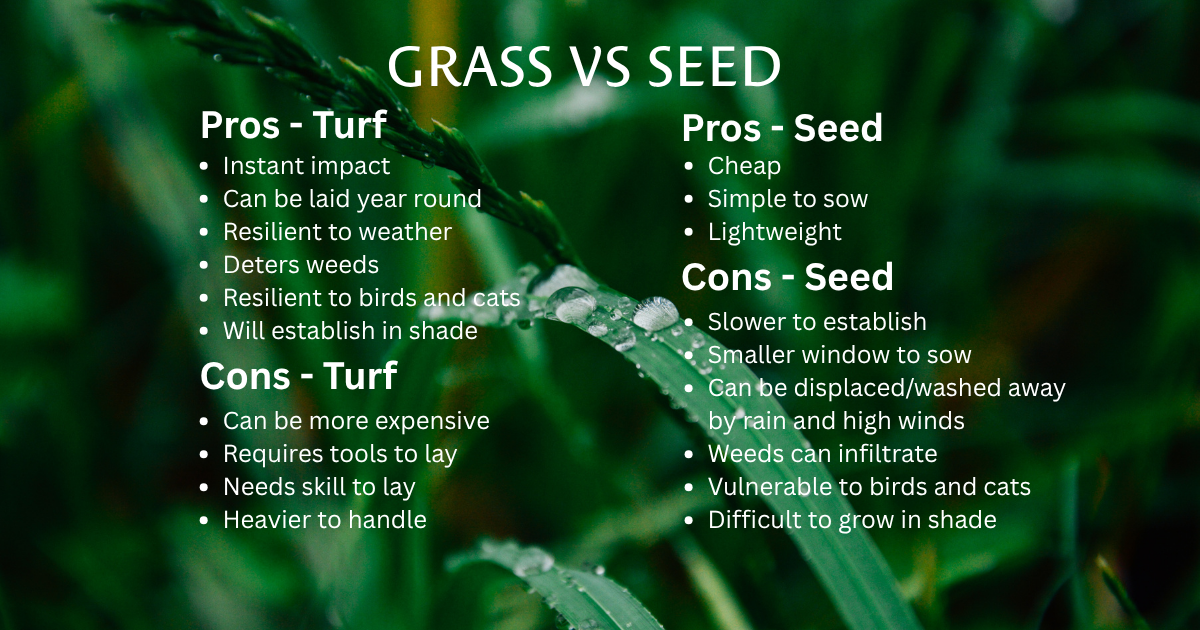
Laying new turf is both convenient and practical. And it gives an instant wow factor! If you have an event or a date in mind to achieve a pristine lawn, then turf is what you need. Unlike seed, it’s not dependent on the season, so it can be laid at any time.

  • You will need to consider the cost and labour required. so the choice depends on your budget, ability to lay (or contract a landscaper) and whether you are in a hurry.
  • Turf will provide a completed and useable lawn just 2-4 weeks after laying. If you choose seed, the length of time it takes to establish is dictated by temperatures and hours of daylight. It could potentially take 2-4 months to achieve similar grass coverage.
  • It’s also worth considering the amount of time it takes to prepare the area for both options. Seed beds will require more labour prior to sowing.
  • Turf can be laid at any time of year, as long as the ground is not frozen. Seed has a much smaller window of opportunity, with ideal sowing times March to May or September and October.
  • There are more potential issues with seeds than turf. Turf is already established whereas seeds have to go through many stages of development. Seeds can be badly affected by extreme weather conditions; for example, torrential rain will wash seeds away and if there’s not enough sun, the seeds just won’t establish.
  • If budget is the driving factor and time is not an issue, then seeding is the cheaper way to go, especially if you are intending on doing all the work yourself.

Best of both

Potentially, and if it suits your budget better, you could use a mixture of turf and seed successfully, especially if the area has more diverse location or soil issues.

  • Places to turf: areas to be used soon with heavy use, and shady, steep or areas with poorer soil quality where it is harder to grow seed.
  • Places to seed: less used areas which aren’t so visible from windows and seating areas.

There are many factors to consider and each garden project is unique. If you have further questions on whether to choose turf or seed for your garden, we would be more than happy to advise.  Please contact us on 01392 231040 or email sales@wesellturf.com

Contact us

01392 231040
sales@wesellturf.com

Office address

HCT Turf
The Old Stable
Clyst Road
Topsham
EX3 0DB

Social media

Why spring is a great season for laying new turf

Why spring is a great season for laying new turf

We tend to advise that autumn is the key season for laying new turf. But with the storms and rainfall experienced in late 2025, some will have put this task on the back burner.

The good news is that spring is also a reliable season to allow new turf to establish successfully, whether you’re replacing a worn‑out lawn or creating a brand‑new one.

The main advantage is soil temperature. By spring, the ground has warmed enough to encourage strong root growth, but it hasn’t yet dried out. Turf needs consistent moisture to establish, and spring naturally provides this through regular rainfall (hopefully much less than we experienced at the beginning of the year). This reduces the amount of watering you need to do yourself, which is especially helpful if you’re covering a large area with new turf.

Spring also offers a long growing season ahead. Turf laid now has several months to bed in before the stresses of summer. Roots can develop properly, the surface can level out and any joins between rolls have time to knit together seamlessly. For returfing, this is particularly useful as patches that suffered from winter waterlogging, moss or compaction can be replaced early, giving the lawn time to recover and blend evenly.

Another practical benefit is that spring weather is generally easier to work in. The ground is softer, making preparation such as removing old turf, levelling soil and adding topsoil much more manageable. You’re also less likely to face the extremes that complicate turfing later in the year, such as heatwaves or prolonged dry spells of last summer.

For new lawns, spring provides a good balance of daylight, warmth and moisture to get turf off to a strong start. Whether you’re landscaping, reshaping borders or creating an area for the family to enjoy, turf laid now establishes quickly and is usually ready for light use within a few weeks.

Overall, spring gives you the best chance of achieving a healthy, resilient lawn with minimal maintenance needs. It’s a season that naturally supports the process, making it both practical and efficient for homeowners and landscapers alike.

Lastly, if you are returfing and need topsoil, we can also supply this. Click here for more information.

Key Points

  • Ideal growing conditions as warmer soil and regular rainfall helps new turf root quickly and evenly.
  • Long establishment period as turf laid in spring has months to strengthen before summer stress.
  • Easier preparation with softer ground and mild weather making soil work and installation more manageable.

We supply quality turf all year round.  If you would like further advice on lawn care or would like to talk to us about your order, please contact us on 01392 231040 or email sales@wesellturf.com

Contact us

01392 231040
sales@wesellturf.com

Office address

HCT Turf
The Old Stable
Clyst Road
Topsham
EX3 0DB

Social media

Ready, set, mow!

Ready, set mow!

As the South West finally starts to dry out and temperatures creep up, lawns across the region are shifting into active growth. That means one thing: mowing season is back. But before you rush to fire up the mower, timing and technique matter more than many people realise.

When is the right time to mow?
The first mow of the season should happen once the grass is actively growing and the ground is firm underfoot. If your lawn is still waterlogged, hold off. Mowing wet soil can cause compaction and ruts as well as damaging fragile new growth. Choose a dry day and make sure the grass isn’t saturated.

Don’t cut too low
One of the most common mistakes people make is to mow very short. This is not a good idea at this time of year, especially after the first growth spurt. Scalping the lawn weakens grass, exposes soil and invites weeds and moss to take hold. A simple rule is the “one-third rule”: never remove more than one third of the grass height in a single cut. Keeping grass slightly longer early in the season helps it establish stronger roots and improves drought resilience later on.

How often should you mow?
Frequency depends on growth, but as a guide, mowing once a week during spring is usually ideal. During periods of rapid growth you may need to mow weekly, while in slower growth it can be less frequent. Regular mowing is a good thing as it encourages thicker turf by promoting lateral growth rather than tall, thin blades.

Seasonal lawn care tips

Check your mower blades. Sharp blades cut cleanly, while dull ones tear grass, leading to browning and stress. Some people go for a full service, offered by some great independent local businesses. One we would personally recommend is M&D Hire in Dawlish.

Spring is also the perfect time to give your lawn some attention beyond mowing. Light scarifying can remove thatch and improve airflow, while aerating compacted areas helps water and nutrients reach the roots. If your lawn looks tired after winter, applying a spring feed can support healthy colour and growth.

Returfing is also worth considering if winter has left your lawn with large bare patches, persistent moss, or areas that simply haven’t recovered. Spring provides ideal conditions for new turf to establish thanks to milder temperatures and increased moisture in the soil. Prepare the ground by removing debris, levelling the surface, and improving soil quality as this will help new turf root quickly and create a consistent, healthy finish that blends seamlessly with existing grass.

Set your lawn up for the season
Good mowing habits now shape how your lawn performs all year. Start high, mow regularly, and avoid cutting when conditions are too wet or too dry. With the right approach, your lawn will thicken, recover from winter, and stay greener through the warmer months.

Ready, set… mow (just don’t rush it).

Key points

  • Start mowing when the lawn is dry and actively growing.
  • Keep blades higher and follow the one-third rule.
  • Mow regularly and repair or returf damaged areas early.

We supply quality turf all year round.  If you would like further advice on lawn care or would like to talk to us about your order, please contact us on 01392 231040 or email sales@wesellturf.com

Contact us

01392 231040
sales@wesellturf.com

Office address

HCT Turf
The Old Stable
Clyst Road
Topsham
EX3 0DB

Social media